
Finding asbestos in the home can be a costly thing to remove. But removing or sealing asbestos in the home can prevent asbestos-related disease and other health problems.
You can expect to find asbestos in a home with most older homes. Many homes in the United States are well over 50 years old and there is a good chance some of them contain asbestos.
Don’t panic if you find asbestos in the home
But if you find asbestos in your home, you shouldn’t panic. At the same time, you shouldn’t take the discovery lightly.
According to the experts, the general rule of thumb is if the asbestos is in good shape, it’s posing no apparent risk. If it’s in bad shape, it could be a problem.
Also, keep in mind that no one knows how much asbestos it takes to get a person sick. But most experts believe there is some risk at any level with asbestos.
In recent years, environmental experts have re-evaluated what steps should homeowners should take when they find asbestos in a home. Depending on the condition of the asbestos, many experts feel it is better to seal it off than remove it.
A few years ago, the mindset was to get the stuff out of the house. Now the mindset is in-house management. Beware, you need to make sure that you remove the asbestos from your home properly. If you remove it improperly, you may end up with more health problems than if you let the asbestos be.
If you find asbestos in the home, Ilyce has written some articles that could help in your search for a home. A home inspection that includes looking for asbestos in a home is of great importance. Remember, removing asbestos can be costly but it should be done right.
Some experts say the greatest health risk comes when you have to disturb the material. Asbestos becomes dangerous when it becomes friable – when it starts to deteriorate and possibly release microscopic fibers in the air.
What is Asbestos
Asbestos is a natural mineral fiber that became a common building material in the early 1900s, when it was found to offer fire-retardant, insulation and acoustical benefits. In the 1960s, however, the fibrous nature of the material was linked to health problems. By 1978, it had been eliminated from new home materials.
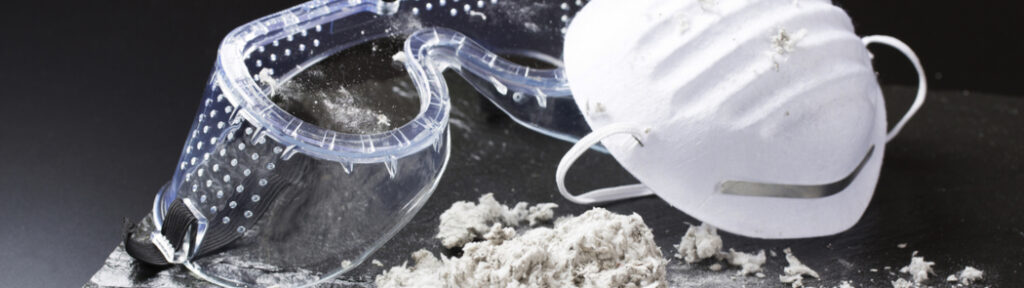
Asbestos is known to cause asbestosis, a potentially fatal scarring of lung tissue, as well as lung and digestive-tract cancers. Researchers believe such diseases stem from inhaling the microscopic fibers of asbestos, which, because of their durability, remain in the lungs for many years. Asbestos-related diseases may take decades to develop, researchers believe.
If your home is more than 25 years old, it’s likely to have asbestos in it, experts say.
Common Places to Find Asbestos in the Home
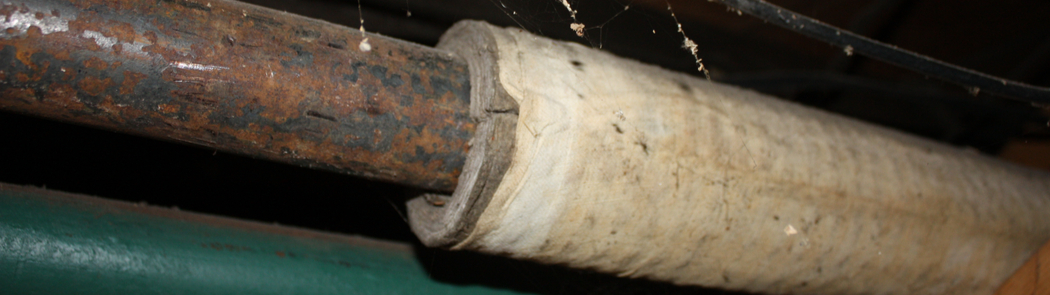
The most common place to find asbestos in a home is in the whitish, cloth-like wrapping on hot water- or steam-heat pipes, which usually are located in a basement. Asbestos wrappings also were commonly used on cold water pipes to prevent condensation.
Pipes, especially at elbow joints, are the first place asbestos usually deteriorates.
Asbestos also may be found on the flues of chimneys, where it’s usually mixed in with mortar and is much less likely to deteriorate than on pipes.
Asbestos also was used in floor and ceiling tiles, in walls and ceilings as insulation or wallboard material and in textured paint. Outside, asbestos can be found in shingles, siding and even cement.
Usually, asbestos in tiles or insulation or wallboard material is not a potential risk unless you are drilling into those materials for some reason and you are breathing the dust.
The best way to look for asbestos in your home is to hire a professional.
How do you know whether it is asbestos?
Experts recommend using a laboratory or an environmental consultant, neither of which will have a financial interest in the outcome of their findings.
If you find asbestos under your roof, you have several options:
– If the asbestos is not friable, you may just leave it alone. If you don’t disturb it, it’s unlikely to cause any kind of risk. However, the asbestos generally needs to be avoided to prevent any potential damage and periodically monitored for any signs of deterioration, especially if any repairs are made in these areas. Material that is suspected to contain asbestos should never be drilled, sawed, sanded, etc.
– Another option for you is to seal the asbestos, a process known as encapsulation. What you’re basically doing is sealing your pipes with a high-tech paint. There are two types of encapsulants: a paint-like material that is coated over the asbestos and a self-setting cement tape that you wet and when it hardens it hardens like a cast.
The encapsulation process also prevents any distribution of asbestos fibers that can take place with the removal of asbestos.
After encapsulating asbestos, you could also build a box around the sealed pipes to limit any disturbances.
Ceiling tiles with asbestos can also be encapsulated by covering them with drywall. And floor tiles suspected of containing asbestos are basically sealed when another layer of tile is placed over them.
© by Jim Sulski